
Agentic Search: How to Prepare for the Acceleration
These days, that is pretty much all you hear from the trade press and from Google: agentic search is coming, and it is going to hit hard. However, beyond the big statements, what does it actually mean for optimizing your site and your business?
Forget about the Fable 5 loss for a few minutes, and immerse yourself in the world of agent visibility:

From ACP to UCP
Agent-specific protocols have already been in service for several months, letting agents discover, compare, and complete a transaction:
- ACP (Agentic Commerce Protocol), created by Stripe and OpenAI, which lets you, for example, buy something directly inside ChatGPT through Instant Checkout.
- UCP (Universal Commerce Protocol), created by Google in collaboration with Shopify, Etsy, and others, which goes further than ACP by covering more steps, from product discovery to final payment.
Here is a look at how UCP works:
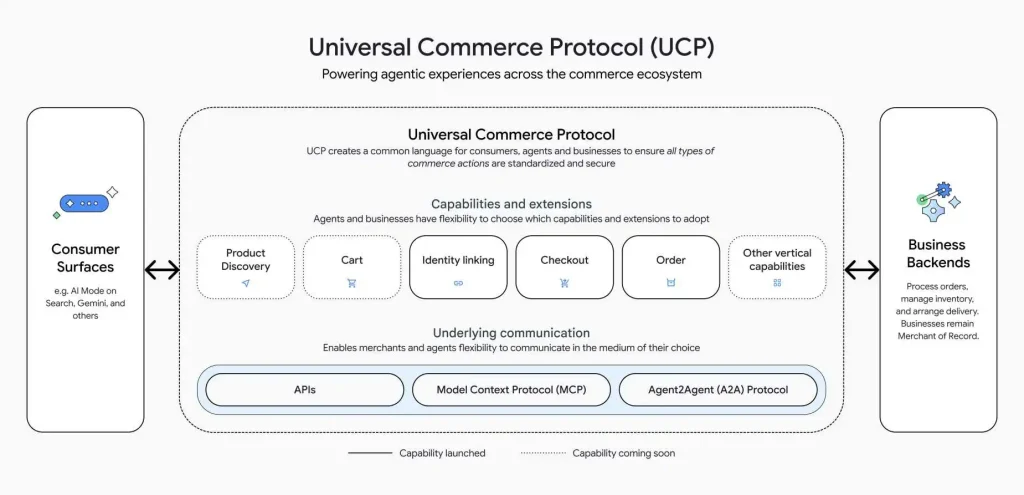
So what does this mean in practice? It means your site needs to be visible to agents that use these protocols, and also to let them explore your pages while making sure they do not get lost along the way.
Here are the levers to pull to become more visible:
- Complete your Schema.org product markup to 100%
- UCP uses its own JSON vocabulary and does not rely directly on schema.org, however schema.org still matters because it helps agents decide who to interact with.
- Attributes like offers, aggregateRating, and shippingDetails no longer just earn you rich snippets in Google search results; they are now queried by agents throughout the process.
- Set up Google Merchant Center
- State your return policy
- Add the native_commerce attribute to be eligible for agentic payments
- Take care of your reviews on sites like Trustpilot
Given that UCP launched this past February, there is no time to waste getting started.
Being Readable by Agents
I have mentioned this in previous newsletters: LLMs do not like client-side rendering. They tend to crawl the HTML, or at least part of it, and they count their tokens before moving on to the next page.
To meet that, there are several requirements:
- Using .md files in Google’s brand-new OKF format (for Open Knowledge Format), which lets you summarize the important points of your site and save tokens
- Creating a .md alternative for every page on the site (if you have a small site with no crawl budget issues), or an inline Markdown code block embedded directly in the HTML
- Adding Schema markup
- Putting the important content in the original HTML and/or using a prerendering solution such as prerender.io to deliver the final HTML to the bots
Putting these measures in place is not necessarily very complicated, however it does require maintenance.
Another Drop in Clicks
In case you have not noticed yet, getting clicks has never been as hard as it is today. Quality is rising, but the click is rare.
One more piece of bad news: clicks will keep dropping as agentic search becomes more widespread. This means that:
- The way you track interactions with your site is going to change, and that will show up in your analytics tools
- The click will lose even more of its strategic value
Get everyone ready for it.
In Short
Riding the emerging agentic wave is the best thing to do right now by adopting the new dedicated protocols and formats.
As for the rest, prerendering and Schema markup, that is SEO, so you were probably already doing it, right?