
AEO TAM: Calculating Your Projections in the Age of AI Search
Calculating your TAM (the total market size for a given service) is a near-mandatory step if you want to put all the odds in your favor when launching a new product or service. Well documented for SEO, it’s a whole different ball game for AEO/GEO, but it’s now possible to know where you’re headed on the AI front with a new launch. Here’s a method to estimate the number of conversions and the revenue you can expect.

The “Old” TAM
If you’re not familiar with what a TAM is and how to calculate one, it basically comes down to exporting your clicks and positions from Search Console, calculating your average CTR, then applying that CTR to the estimated search volume for your new service (exported from Semrush or Ahrefs), and finally applying your average conversion rate. You end up with the number of dollars you can reasonably expect.
Here are the steps:
- Run keyword research with your favorite tool (Semrush, Ahrefs, etc.) and select the keywords you’re interested in. Export them and paste them into a Google Sheets spreadsheet.

- Export the keywords your site ranks for from Google Search Console, along with clicks, CTR, and position data over a given period (1 to 3 months). Remove anything with fewer than 5 clicks, a position above 10, and branded keywords.


- Now create a separate table with 3 rows:
- Position 1-3
- Position 4-6
- Position 7-10
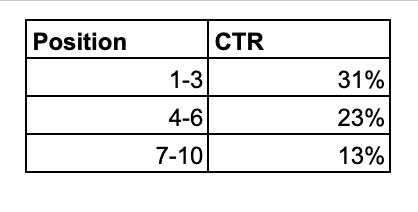
- You now have 3 scenarios: optimistic (pos. 1-3), neutral (pos. 4-6), and pessimistic (pos. 7-10). All that’s left is to multiply the total monthly search volume pulled from Ahrefs/Semrush by each average CTR to get your monthly traffic prediction.

- Now take your average organic conversion rate (CVR): you can calculate your estimated monthly conversions per scenario by multiplying estimated traffic by your CVR.

This method still works very well for traditional search, even though CTRs are obviously declining year after year.
The AEO TAM
Can the same thing be done with AI search? Partly. The main difficulties come down to two points:
- AI search isn’t tied to the click as a performance indicator
- Available data is limited
That said, the impressive progress made by Bing Webmaster Tools can serve as our foundation. The AI impressions starting to show up in Search Console probably won’t be much use to you if you’re focused on the French market. But since Google seems ready to roll out AI Overviews (AIO) in France by September, this is the perfect time to get ready. A dose of proactivity can go a long way.
Here’s how to calculate your AI projections:
- Make sure you have a Bing Webmaster Tools account. You can import your Search Console settings in two clicks.
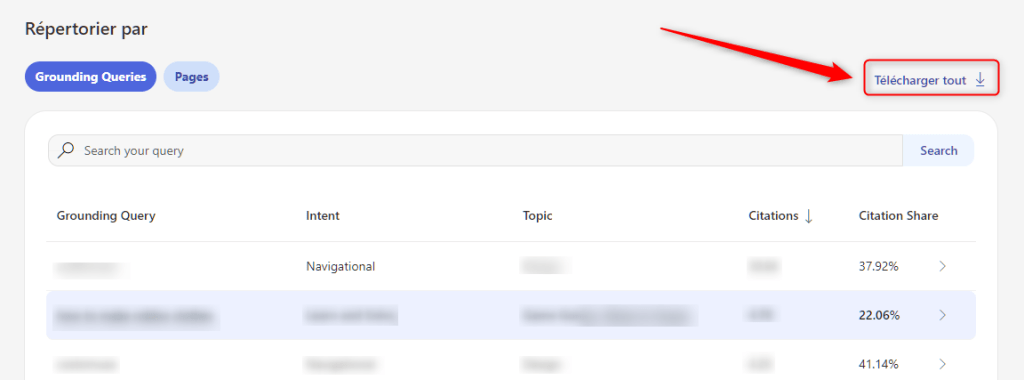
- In the “AI Performance” tab, select a 6-month period (ideally 12, but there isn’t enough data available yet), then scroll down to the “List by” section and click “Download all.”
- Open the generated CSV file, then remove all branded queries from the “Grounding Query” column, along with every query that has fewer than 5 citations in the “Citations” column.
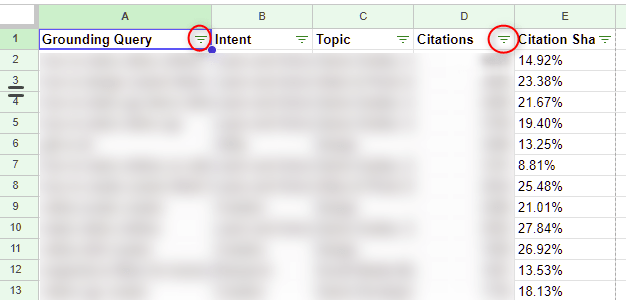
- Now, simply take the total number of citations and average the citation rate. For this example, let’s say 120,000 citations and a citation rate of 20.04%. Since we’re capturing 20.04%, that means there are roughly 600,000 total citations up for grabs.
- Since this is Bing, we’ll use the average number of citations per answer given by Copilot, which currently sits at around 4. You can run several prompts yourself and count the citations for more accuracy. So let’s divide the citations up for grabs by 4 citations on average, which gives us 150,000 total answers. That’s the surface area to conquer, so to speak. Divide that by 6, and we get 25,000 answers per month.
- We now need to determine the value of a citation. That means knowing:
- How much a conversion is worth. Let’s say $180 here (or €180 if you’re working in euros).
- The number of clicks coming from AI assistants divided by the number of citations = the click rate. Out of 120,000 citations, there were 4,000 clicks, so 4,000/120,000 = a 3.33% click rate. Of those 4,000, 500 become customers (12.5%), so 500 x 180 = $90,000. This data is available in your analytics tool, such as GA4.
- The number of people who don’t click but remember the brand name. This is a hypothetical figure, as it’s very hard to estimate. Use 1% for a conservative projection and 3% for a more standard one. The value of a citation is therefore: (3.33% x 12.5% x $180) + (3% x $180) = 0.75 + 5.40 = $6.15 per citation The formula: click rate x conversion rate x conversion value + no-click brand recall = value of a citation
- Out of the 100,000 monthly citations in play (600,000 ÷ 6), we already capture 20,000 (120,000 ÷ 6). If we want to double our slice of the pie to 40,000 through X actions, the business stands to gain 20,000 × $6.15 = $123,000 per month. That’s a simple (if imperfect) way to communicate value.
- How much a conversion is worth. Let’s say $180 here (or €180 if you’re working in euros).
The Gaps
Plenty of points in this AEO TAM are of course debatable:
- A deferred traffic percentage with no solid basis
- Probably too much weight given to the click
- Based on Grounding Queries, not on prompts
- No way to estimate the total number of answers for topics where the site isn’t cited yet
- Based on Bing and Copilot
As you’ll have gathered, this is a largely imperfect method, but it has the advantage of enabling an estimate and helping convince stakeholders to invest resources in AI search, before new tools and new data become available soon.
With AI Overviews potentially about to land in Google search results, now is the right time to give it a shot.